
Pearson 35
Built 1968–1982 by Pearson Yachts
About the Pearson 35
Researched from public sources for this model. Any individual boat may have been modified or repowered — confirm before relying on any figure.
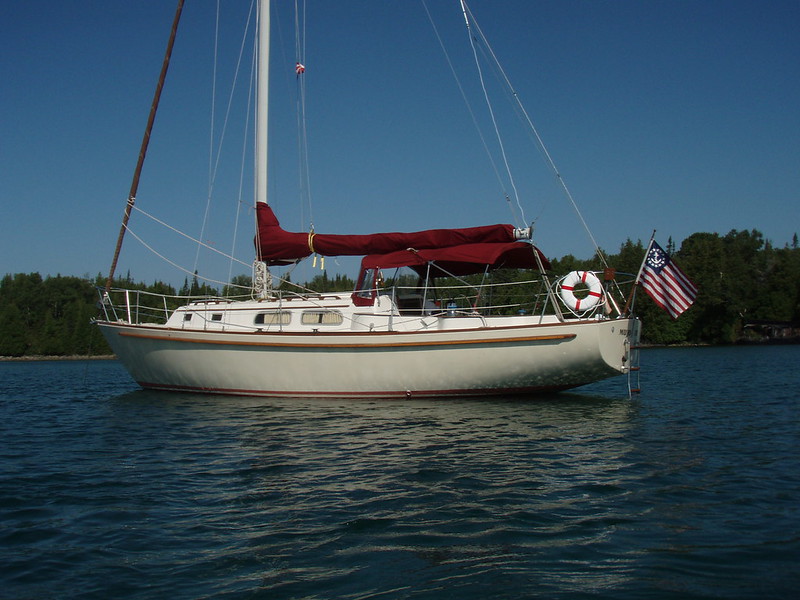
- Built
- 1968–1982
- Builder
- Pearson Yachts
- Designer
- William Shaw
- Length
- 35 ft
- Waterline
- 25 ft
- Beam
- 10 ft
- Draft
- 3.75 ft
- Displacement
- 13,000 lb
- Ballast
- 5,400 lb
- Hull / keel
- centerboard
- Rig
- sloop
- Propulsion
- inboard
- Fuel
- 18 gal
- Water
- 78 gal
- Number built
- 514
- Stern thruster
- none
Keel/centerboard hull, draft 3.75 ft board up and 7.5 ft down. Yawl rig was optional. Largely unchanged 1968-1982; mid-1970s the dinette layout was replaced by a settee layout. Atomic 4 standard, Farymann diesel optional from about 1975, later Westerbeke and Universal diesels (sailboatdata also names Yanmar). Not to be confused with the late-1990s Pearson 35 derived from the 34-2. Sources read do not state whether the hull is solid or cored.
Known problems for this model
-
Centerboard pivot and pennant hull
The board, trunk, pivot and pennant need regular maintenance and a thorough survey check; some owners have pinned the board up.practical-sailor.com
-
Leaking ports, hatches and deck fittings deck
Aluminum ports, fiberglass hatches, stanchion and chainplate penetrations, and sometimes the hull-deck joint tend to leak with age.practical-sailor.com
-
Difficult engine access and repowering engine
Access to the Atomic 4 is marginal and worse for diesels; owners' most common complaint is how hard it is to retrofit a diesel.practical-sailor.com
-
Fuel tank condition fuel
Have the fuel tank checked professionally, as repair or replacement is not easy.practical-sailor.com
-
Gelcoat crazing hull
Gelcoat crazing is a common complaint; blistering is about average for boats of the era.practical-sailor.com
Engines & parts
Universal Atomic 4 parts: good
Factory standard engine — you entered “Universal Atomic 4”
Tens of thousands were built (sources say from 40,000 to 50,000). Despite being out of production for decades, the engine is well supported: Moyer Marine sells parts, rebuilt engines, fuel pump rebuilds and exhaust parts, and hosts an owners' forum; Old Lyme Marina and others also supply parts, and electronic ignition upgrades are available.
Parts sources: Moyer Marine
Common problems (3)
-
Raw-water cooling scale and corrosion cooling
Most Atomic 4s are raw-water cooled, so the block scales up and corrodes, especially in salt water; cranking without starting can also flood the engine with seawater through the exhaust.goodoldboat.com · moyermarineforum.com · keelindex.com
-
Gasoline vapor fire/explosion risk fuel
Gasoline vapor is heavier than air and settles in the bilge, so ventilation, blower use and shutting the fuel valve (a stuck carburetor float can overflow) matter.goodoldboat.com
-
Ignition and fuel system faults electrical
Points, condenser, cap and wires, plus gummed carburetors and contaminated fuel, are the most common reasons an Atomic 4 won't run well.keelindex.com · goodoldboat.com
Sources disagree on first year, last year, number built — left blank rather than guessed.
Model sources (3)
Other Pearson models
- Pearson 26 1970–1983
- Pearson 30 1971–1981
- Pearson 323 1976–1983
- Pearson 34 1983–1986
- Pearson 365 1976–1982
Researched from public sources. Spotted an error? The sources are listed above — tell us what they got wrong.